
Agentic AI in eCommerce Operations: A Practical Playbook for UK Retailers
By: Vijay Kumar

Most UK retailers have tried a chatbot by now. Far fewer have put an AI agent to work inside operations, which is where the hours and the margin actually leak: chasing late purchase orders, re-keying marketplace listings, deciding what to do with the 3% of orders that do not fit the happy path. Those jobs are repetitive, rule-heavy and exhausting, and they are exactly what agentic AI is good at.
This article is the playbook we wish more operations teams had before their first agent project. It covers what an agent is and is not, the five workflows that pay back first, the guardrails you should refuse to launch without, a 90-day rollout plan and the handful of numbers that tell you whether it worked. If you want the business case first, read The Real ROI on AI Agents for UK Enterprises and come back.
What an AI agent is, and what it is not
A chatbot answers questions. An agent is given a goal, a set of tools and a set of rules, and it works through the steps to reach the goal. The tools are the important part. In eCommerce they are your order management system, your stock data, your marketplace APIs, your supplier portals and your email.
That makes an agent different from the two things it gets confused with:
- It is not a chatbot. A chatbot sits in a conversation and waits. An agent reads an order queue at 6am, notices a pattern, and raises a ticket or takes an action without anyone typing.
- It is not traditional automation. Rules-based automation breaks the moment the input is messy. A courier email that says “parcel refused, returning to depot” in six different formats defeats a rule. An agent reads it, classifies it and does the right thing.
The flip side is that an agent can act, so it needs controls that a chatbot never did. Keep that in mind throughout this article. Every recommendation below assumes a human can see what the agent did and stop it.
Five operational workflows where agents pay back first
Start where the work is high volume, rule-heavy and already measured. These five fit most UK retailers we work with.
1. Order exception handling
Most orders flow through untouched. The small share that does not (address fails validation, payment flagged, item out of stock after the sale, split shipment needed) eats a disproportionate amount of staff time. An agent can triage each exception, pull the context from your order system and courier, and either resolve it within an agreed policy or hand it to a person with a one-paragraph summary and a recommended action. The win is not the resolution itself. It is that a person no longer spends ten minutes finding out what happened before they can decide.
2. Stock and replenishment
Replenishment is a forecasting problem wrapped in a logistics problem. An agent that watches sell-through by SKU and channel, knows supplier lead times and minimum order quantities, and drafts purchase orders for approval will usually beat a weekly spreadsheet review. The approval step matters. The agent proposes, a buyer approves, and over time the buyer approves faster because the proposals are consistently right. We built this pattern into Vastyn for multi-marketplace sellers because it was the first thing every seller asked for.
3. Marketplace listings and repricing
If you sell on Amazon, eBay, OnBuy and your own store, you already know the pain of keeping titles, attributes, images and prices consistent. An agent can detect a listing that has drifted from your master product data, correct it within your brand rules and flag anything it is unsure about. On pricing, an agent can hold a margin floor and a competitor rule set and move prices within those limits, which is both faster and safer than a person doing it at 5pm on a Friday.
4. Returns triage
Returns are a classification task with a policy attached. Did the customer give a reason? Is the item resaleable? Is this the fourth return from the same account this month? An agent can read the return request, apply the policy, issue the label and route the item to the right bin, and it can escalate the edge cases with the evidence attached. The customer gets an answer in minutes rather than days, and your returns team spends its time on the cases that need judgement.
5. Supplier and purchase order chasing
Nobody enjoys chasing suppliers. An agent can read your open purchase orders, notice which ones are late against the promised date, send a polite chaser in your tone of voice, parse the reply, and update the expected date in your system. If a supplier goes quiet or a delay will cause a stock-out, it tells a person. This workflow is low risk, immediately visible and a good first project if your team is sceptical.
The guardrails you should refuse to launch without
An agent that can act on your systems is a member of staff with a very fast keyboard. Treat it that way.
- Scoped permissions. The agent gets the minimum access it needs for the one workflow it owns. A replenishment agent reads sales and stock and writes draft purchase orders. It does not touch refunds.
- Approval gates. Any action that moves money, changes a price outside a band, contacts a customer, or deletes data goes to a person first. You can relax individual gates later, one at a time, once the record justifies it.
- An audit log you can read. Every action the agent takes is recorded with the inputs it saw, the rule it applied and the result. If a customer complains, you can show exactly what happened. This is also how you satisfy the accountability principle under UK GDPR.
- Thresholds and kill switches. If the agent proposes more than an agreed number of actions in an hour, or its confidence drops, it pauses and asks. Someone on your team can stop it with one click.
- Data stays where it lives. The agent calls your systems through their APIs. It does not need a copy of your customer database, and it should not have one. Check where the underlying model is hosted and whether your transfer arrangements cover it.
We described how we structure these controls in the agentic AI section of AI at Versatile Commerce. The short version: agents work under human approval gates by default, and autonomy is earned.
A 90-day rollout plan
The build is usually the quickest part of an agent project. Most of the elapsed time goes on connecting systems properly and building trust. This plan assumes one workflow, clean enough data and a named owner on your side.
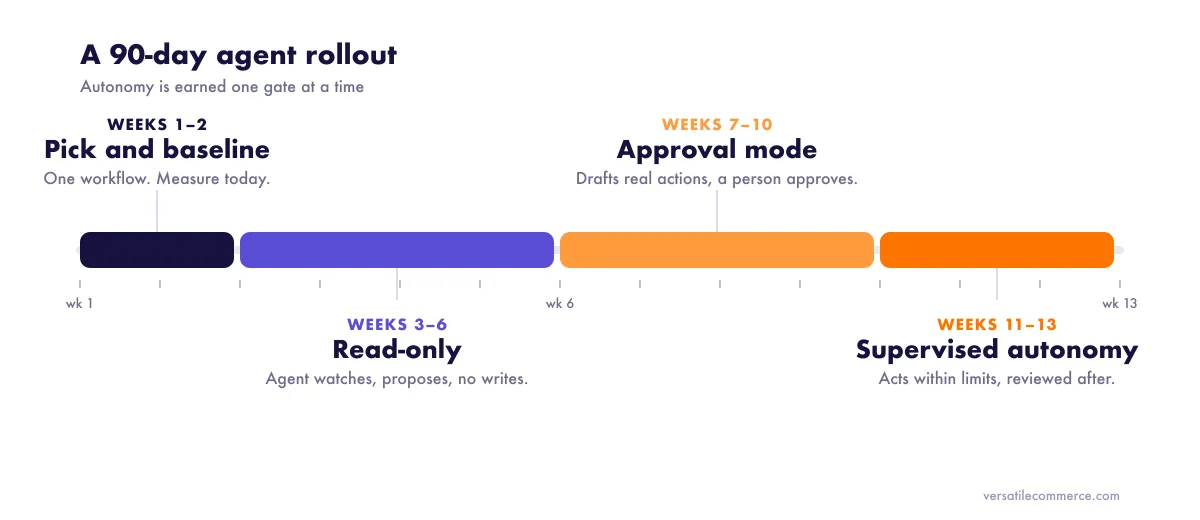
Weeks 1 to 2: pick and baseline. Choose one workflow from the list above. Measure how it performs today: volume, time per case, error rate, cost. Write down the policy the agent must follow in plain English. If your team cannot agree the policy, you have found the real problem, and it is not technical.
Weeks 3 to 6: build in read-only mode. Connect the agent to the systems it needs with read access only. Let it watch the live workflow and produce the actions it would have taken. Compare those against what your team actually did. This is where you discover the exceptions nobody mentioned.
Weeks 7 to 10: approval mode. The agent now drafts real actions and a person approves or rejects each one. Track the approval rate and the reasons for rejections. Fix the rules, not the people.
Weeks 11 to 13: supervised autonomy. For the categories of action with a consistently high approval rate, let the agent act and review afterwards. Keep the gates on everything else. Report the results against the week 1 baseline.
If you are starting from a platform migration or a stack with no usable APIs, read How to Scale eCommerce from 100 to 10,000 Orders a Month first. Agents amplify whatever operational foundation they sit on, including the cracks.
How to measure whether it worked
Keep the dashboard short. Five numbers, compared against the baseline you took in week 1, tell the story.
| Measure | What it tells you | Illustrative target |
|---|---|---|
| Cycle time per case | How long an exception, return or PO query takes from open to closed | Hours down to minutes for routine cases |
| Exceptions per 1,000 orders needing a person | Whether the agent is absorbing the routine work | Falling month on month |
| Approval rate | How often a person accepts the agent’s proposed action | Above 90% before relaxing a gate |
| Hours returned to the team | Staff time freed for work that needs judgement | Agreed per workflow at kick-off |
| Error and reversal rate | Actions that had to be undone or corrected | At or below the human baseline |
The targets in the last column are illustrative. Your own baseline sets the real ones. Resist the temptation to report model accuracy or tokens used. Your finance director does not care, and neither should you.
Mistakes we see most often
- Starting with the customer-facing workflow. It is the most visible and the least forgiving. Start with internal operations and earn the right to go further.
- Skipping the baseline. Without week 1 numbers you cannot prove anything, and the project becomes a matter of opinion.
- Letting the agent work from a data export. Agents need live data through proper integrations. A nightly CSV guarantees stale decisions.
- Treating the policy as a technical detail. The rules the agent follows are a business decision. Write them down, agree them and version them.
- Buying a generic agent and hoping. Off-the-shelf tools are fine for generic tasks. Your operations are not generic. Bespoke software built around your systems and your rules is usually what makes the difference between a demo and a result.
Where to start
If one of the five workflows above made you wince in recognition, that is your first project. Baseline it this month, write down the policy, and talk to someone who has connected agents to real order, stock and marketplace systems before.
Our eCommerce managed solutions team runs operations for UK retailers every day, and our AI team builds the agents that sit inside them. If you would like a frank conversation about whether an agent is the right answer for your operation, get in touch.
Frequently Asked Questions
What is the difference between an AI chatbot and an AI agent in eCommerce?
A chatbot answers questions in a conversation. An agent is given a goal and a set of tools, such as your order system, stock data and supplier portal, and works through the steps to reach that goal. It can read, decide and act, which is why it needs approval gates and scoped permissions that a chatbot never did.
Which eCommerce workflow should we automate with an agent first?
Pick the one that is high volume, rule-heavy and already measured. Order exception handling and stock replenishment usually fit. Avoid anything customer-facing or anything that touches money until the agent has run in approval mode for several weeks with a clean record.
How do AI agents fit with UK GDPR?
The same way any processor does. Keep personal data inside the systems it already lives in, give the agent the minimum access it needs, log every action, and be able to explain any decision that affected a customer. If the model is hosted outside the UK or EU, check your transfer arrangements before go-live.
How long does it take to get an agent into production?
For a single, well-scoped workflow with clean data, plan for about 90 days from kick-off to supervised autonomy. The build is the fast part. Most of the time goes on connecting systems properly, agreeing the rules the agent must follow, and running in approval mode long enough to trust it.