Black Friday 2026 Under the DMCC Act: Nine Pricing Rules UK Online Retailers Must Get Right
By: Vijay Kumar
Black Friday is on 27 November, and this is the first peak season where the Competition and Markets Authority can fine a retailer directly for the way it presents a price. It has already done so four times this year, to the tune of more than £10m, and on 2 November it wrote an open letter to every online retailer in the country reminding them that mandatory delivery fees belong in the headline price. It said that where it sees non-compliance continuing, it may use its enforcement powers.
None of the rules below is new in spirit. Honest pricing has been the law for decades. What is new is the cost of getting it wrong, and the fact that the CMA no longer needs a court to collect. This article sets out what has changed, who has been fined and for what, the nine rules to check your store against, and a one-week audit you can run before the sale starts. It is written for retail and eCommerce teams, not lawyers, and it is not legal advice.
What changed on 6 April 2025
The Digital Markets, Competition and Consumers Act 2024 rewrote the UK’s consumer protection rules and handed the CMA direct enforcement powers. The consumer provisions apply to anything a business did from 6 April 2025 onwards. Three changes matter most for peak trading.
- The CMA can fine without going to court. Up to 10% of global turnover, or £300,000 if that is higher. Breaching undertakings or directions carries a further penalty of up to 5% of turnover.
- A list of practices is banned outright. Fake urgency, fake reviews and drip pricing are on it. For a banned practice the CMA does not have to show that anyone was misled. The practice itself is the offence.
- The total price must be the first price. Any mandatory fee, tax or charge has to be in the price the shopper sees first. If it cannot be calculated in advance, the method must be shown.
The CMA published detailed guidance on all of this: CMA207 on unfair commercial practices, CMA208 on fake reviews and CMA209 on price transparency. They are long. The rest of this article is the short version for Black Friday.
Who has been fined, and for what
Every fine so far has been for a practice that most retailers would have called normal three years ago.
| Business | Date | Fine | What it did |
|---|---|---|---|
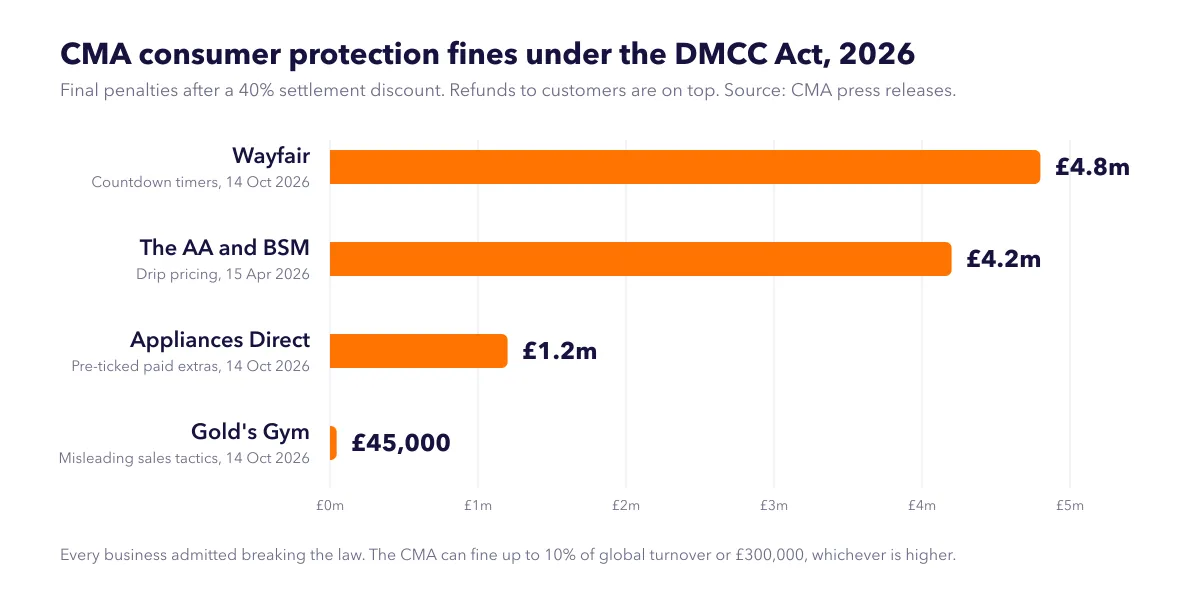
| The AA and BSM driving schools | 15 April 2026 | £4.2m, plus over £760,000 in refunds | Added a mandatory £3 booking fee that was not in the upfront price |
| Wayfair | 14 October 2026 | £4.8m | “Daily Deals” and 24-hour “Flash Deals” with countdown timers, where many products stayed at the same or a lower price after the deadline |
| Appliances Direct | 14 October 2026 | £1.2m, plus around £432,000 in refunds | Automatically opted customers into paid “Remove & Recycle” and installation services, and showed “limited time” discount codes that recurred for days |
| Gold’s Gym | 14 October 2026 | £45,000, plus £9,220 in refunds | Misleading sales tactics on membership |
Source: CMA press releases, 15 April 2026 and 14 October 2026. Every business admitted breaking the law and received a 40% reduction for settling early, so the pre-discount penalties were roughly £7m and £8m for the AA and Wayfair respectively.
Two details are worth sitting with. The AA’s fee was £3, the refund averaged about £9 per customer, and the fine was still £4.2m. And Wayfair’s timers were not fake in the sense of being invented; they counted down accurately. The breach was that the offer did not end when the clock did. Investigations are also open into Trainline, Virgin Atlantic and RED Driving School over drip pricing, Emma Group and Simba Sleep over urgency and price reduction claims, and several businesses over reviews. The CMA is clearly working through peak-season tactics one by one.
The nine rules
1. The first price is the total price
If delivery or collection is mandatory, it must be inside the price on the advert, the product page, the basket and the checkout. The CMA’s open letter of 2 November suggests showing the price both with and without delivery if your delivery is a flat basket charge. If delivery is optional or varies by postcode, say so clearly at every stage and explain how it is worked out. Information behind a link, a pop-out or an expandable section does not count. The same goes for any other unavoidable charge: a booking fee, a service fee, a card surcharge.
2. Nothing paid is pre-ticked
Appliances Direct was fined for opting customers into paid recycling and installation by default. Every optional extra starts unselected, is priced next to the tick box, and is removable without leaving the basket. Check your checkout for protection plans, gift wrapping, express delivery and donations.
3. A countdown ends when it says it ends
Timers are legal. Timers that restart, roll over to a new identical offer, or sit next to a price that does not change when they hit zero are a banned practice, whether or not anyone was misled. The CMA’s own example in its guidance is exactly the restarting clock. Make the timer the same for every visitor, tie it to a real price change in your system, and keep a log that shows the price moved.
4. “Was” prices are prices people actually paid
A reference price must be one customers could genuinely have paid, for long enough to be real, and recently enough to be relevant. The UK has no fixed EU-style 30-day lookback, but that cuts both ways: there is no safe harbour either. Record, for every promoted line, the date the higher price last applied and for how long. The government announced in August that it will consult this autumn on banning fake “was” prices, invented discounts and misleading RRPs outright, so this is the rule most likely to tighten next.
5. “Up to 50% off” means a meaningful share of items are at 50% off
A headline saving that applies to a handful of lines, while most of the sale is 10% off, is misleading. Before you publish the banner, run the query: what proportion of products in the promotion actually carry the headline discount? If the answer embarrasses you, change the banner.
6. An RRP is a real price in the real market
“RRP £199, now £99” is a comparison claim, and you need evidence that £199 is a price the product is genuinely sold at by others. An RRP the manufacturer invented for your sale is not. Keep the evidence with the product record.
7. The sale ends when you said it would
“Ends Sunday” means ends Sunday. Extending the sale, or relaunching it on Monday under a new name at the same prices, turns the original end date into a false urgency claim. Fix start and end dates before launch, publish them, and if you must extend, treat it as a new promotion with a new reference point.
8. Scarcity claims are true and current
“Only 3 left”, “12 people are looking at this” and “selling fast” are all fine if they come from live data and are true for the visitor seeing them. The CMA’s guidance gives “sold 10 in the last 5 minutes” as a misleading claim when stock is high. If a plugin generates these messages from nothing, switch it off before the sale.
9. Reviews are checked, and incentives are declared
Publishing reviews without taking reasonable and proportionate steps to prevent and remove fake or undisclosed-incentive reviews is a banned practice. In practice that means a written review policy, a way to verify purchase, removal of reviews you cannot stand behind, and a clear label on anything that was rewarded. If you import reviews from a third-party platform, you are still the publisher.
The one-week audit
Two weeks is enough to find and fix the obvious problems. Here is a sequence that works for a team of two or three.
- Day 1, walk the journey. On a phone, from a paid social ad through product page, basket and checkout to the confirmation email. Note every price shown and every point at which it changes. Any change that is not an optional extra the customer chose is a problem.
- Day 2, pull the price history. For every line in the Black Friday promotion, export the price history for the last 90 days. Flag any “was” price that was charged for less than a few weeks or not at all, and any line where the sale price is the same as the normal price.
- Day 3, inspect the urgency features. List every countdown, stock counter, “X people viewing” and “limited time” element on the site and in email. For each, write down what data drives it and what happens when it expires. Anything you cannot explain gets removed.
- Day 4, check the extras. Open the basket and checkout with a fresh session and confirm nothing paid is pre-selected. Check the mobile app and any marketplace listings separately.
- Day 5, review the reviews. Confirm your review policy is published, verified-purchase labels work, and incentivised reviews are marked. Spot-check the ten most reviewed sale products.
- Day 6, fix and document. Keep a dated record of what you checked and what you changed. If the CMA ever asks, showing that you looked is worth a great deal.
- Day 7, brief the people on the day. The marketer who extends a sale at 11pm because it is going well, and the merchandiser who bumps a reference price, need to know the rules before Friday.
If your platform cannot show a total price including delivery on the product page, or cannot log price changes, that is a development job rather than a policy one, and it is the kind of thing our managed eCommerce team handles for UK retailers every week. For the commercial side of planning the discount ladder itself, see our UK Christmas 2026 forecast and its section on discounting.
Why this is good news for honest retailers
It is easy to read a list like this as a burden. It is also a levelling of the field. Adobe’s forecast expects average discounts to reach 25% over Cyber Weekend, and a retailer that will not invent a “was” price has struggled for years against competitors who would. The CMA’s fines, and the consultation on fake discounts that is coming, make that competitor’s tactic expensive. An honest 15% off a real price, shown in full with delivery, is now a stronger position than a fictional 40%.
If you want a second pair of eyes on your sale before it goes live, or a platform fix for the total price, get in touch. The first conversation is free.
Frequently Asked Questions
Can the CMA fine my business directly for Black Friday pricing?
Yes. Since 6 April 2025 the CMA can impose fines under the Digital Markets, Competition and Consumers Act without going to court, up to 10% of global turnover or £300,000, whichever is higher. It has used that power four times so far in 2026: the AA (£4.2m), Wayfair (£4.8m), Appliances Direct (£1.2m) and Gold's Gym (£45,000), all after a 40% discount for settling early.
Is a Black Friday countdown timer illegal in the UK?
No, as long as it is true. The banned practice is falsely saying an offer ends at a set time. A timer that reaches zero and restarts, or a deal that stays at the same price after the clock runs out, is a breach regardless of whether anyone was harmed. That is what Wayfair was fined £4.8m for in October 2026.
Does the UK have a 30-day lowest price rule for 'was' prices?
Not yet. The EU has one; the UK does not have a fixed lookback period. The rule is that a reference price must be one that customers genuinely could have paid for a meaningful period. The government announced in August 2026 that it will consult on an outright ban on fake 'was' prices, invented discounts and misleading RRPs, so keep records of your real prices now.
Do I have to include delivery in the product price?
If the delivery fee is mandatory, yes. The CMA's open letter of 2 November 2026 says the total price, including unavoidable delivery or collection fees, must be shown at every stage where a price appears, from advertising through product page, basket and checkout. If delivery is optional or varies, you must say clearly and early that a charge applies and how it is worked out.