UK Christmas 2026: A Record £28.5bn Online, and AI Is Sending the Shoppers
By: Vijay Kumar
Every November the forecasts arrive and most of them say the same thing: online will grow a bit, Black Friday will be big, shoppers are cautious. This year’s Adobe forecast says that too, but one line in it is different. Traffic to UK retail websites from AI platforms is expected to rise 214% year on year over November and December. That is not a chatbot on your own site. That is ChatGPT, Gemini, Copilot and their peers reading your catalogue and sending shoppers to you, or to a competitor, with a product already chosen.
This article walks through the forecast as reported by Retail Gazette on 5 November, explains what sits behind the headline numbers, and sets out what a UK retailer can still change in the three weeks before Black Friday on 27 November.
The headline numbers
Adobe’s UK holiday forecast covers 1 November to 31 December. The figures below are from the Retail Gazette report. Retail Week quoted the same forecast with a slightly higher total of £28.92bn, and neither outlet explained the gap, so treat the total as “a little over £28.5bn” rather than a precise point.
| Measure | Forecast | Change on 2025 |
|---|---|---|
| UK online spend, 1 Nov to 31 Dec | £28.52bn | +6.2% |
| Total Q4 eCommerce sales | £40bn | +6.4% |
| Black Friday, 27 November | £1.24bn | +7.1% |
| Cyber Weekend, four days | £4.05bn | +6.6% |
| Cyber Monday, 30 November | Over £1bn for the first time | |
| Traffic from AI platforms, Nov and Dec | +214% | |
| Revenue share from social networks | +24% | |
| Sales volume in the highest-priced product tier | +13% |
Source: Adobe UK holiday forecast, via Retail Gazette, 5 November 2026.
Three things stand out. Growth of 6% is solid but not spectacular, and it comes against a backdrop of Next telling investors it expects muted UK sales as household bills and mortgage costs bite. Black Friday is growing faster than the season as a whole, so the peak is getting peakier. And the AI line is growing at thirty times the rate of everything else.
Where the AI traffic comes from
The 214% figure needs some care. It is growth from a small base, and it measures referrals from AI platforms, not sales. But the September figure of 111% shows the base is no longer tiny and the growth is accelerating into peak, which is exactly when it matters.
What is happening is a change in where the shopping journey starts. A shopper who once typed “best cordless vacuum under £200” into a search engine now asks an assistant the same question and gets three products back, with prices, pros and cons and a link. Google’s AI Mode, ChatGPT shopping, Microsoft Copilot and the Perplexity assistant all do this today. Meta is launching its Muse shopping assistant in the UK within weeks. Amazon has blocked some of these agents from its store. Walmart has opened its doors to them. Shopify reports that orders from AI search on its platform rose 3.3x year on year in the third quarter.
The practical consequence for a UK retailer is simple. If an assistant cannot read your product data cleanly, you are not in the three results. If it can, you receive a visitor who has already compared you and decided you are worth a look. Those visitors convert better than cold search traffic, which is why the revenue effect will be larger than the traffic share suggests.
We covered the operations side of this shift in our agentic AI playbook for UK retailers. This is the customer side, and it needs different work.
The discount ladder
Adobe’s forecast describes how discounting builds through the season. Average discounts start at 12% in early November, reach 18% in the run-up to Black Friday and hit 25% over Cyber Weekend.
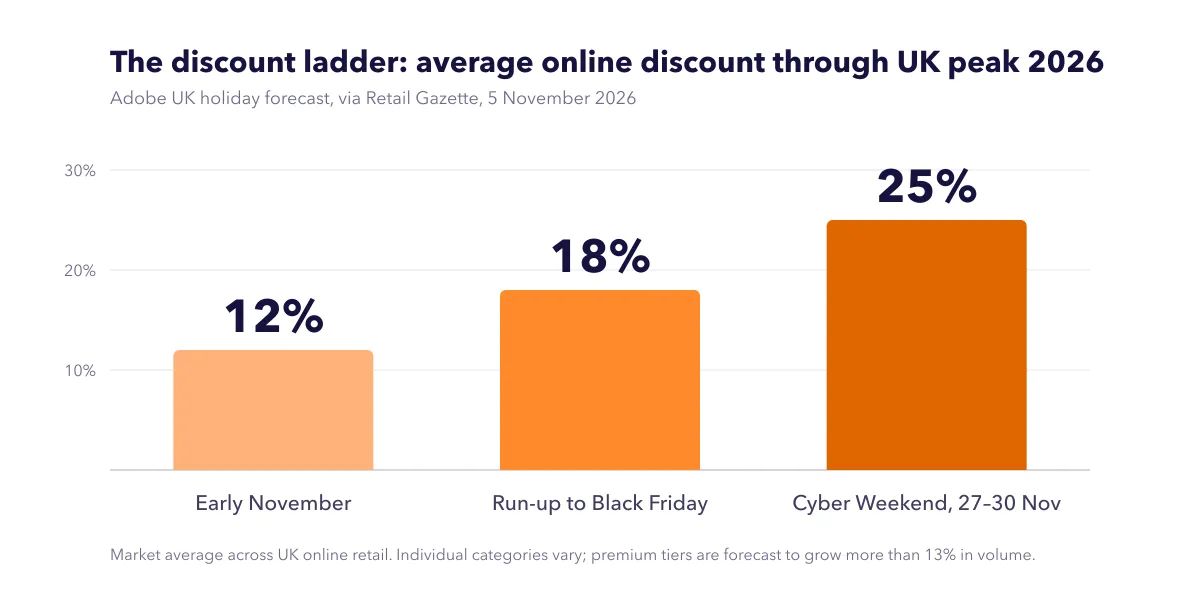
That ladder has two implications.
The first is that shoppers know it exists. Many UK retailers started their sales on 28 October this year, and a shopper who sees 12% off in week one has every reason to wait for 25% in week four. The forecast’s point about essentials makes this visible: online orders for clothing basics are expected to rise 215% in Cyber Week compared with pre-season levels. People are holding the boring purchases back for the deepest discount.
The second is that the ladder is an average, not a rule. The same forecast expects sales volumes in the highest-priced product tier to rise more than 13%, with personal care, sporting goods and electronics leading. Shoppers who are cutting back on quantity are trading up on the things they do buy. A retailer with a clear premium story does not have to climb the full ladder to win the season, but it does have to make the value case on the product page, because the shopper is comparing harder than ever.
One warning before you plan your own ladder. The Digital Markets, Competition and Consumers Act now bans drip pricing, and the government has promised a consultation this autumn on adding fake “was” prices and invented discounts to the banned list. A 25% discount off a price you only charged for a fortnight in October is the kind of thing that consultation is aimed at. Keep your reference prices honest and your records of them tidy.
What a UK retailer can still do before Black Friday
There are three weeks left. That rules out a replatform, a new loyalty scheme or a campaign you have not already shot. It does not rule out the fixes that move the numbers above, and most of them are data and plumbing rather than marketing.
1. Make your products readable by machines
AI assistants build their answers from structured data: schema.org Product markup, a clean Google Merchant Center feed, consistent titles, real GTINs, stock status and delivery promises that are actually true. Run your top 50 products through Google’s Rich Results Test and fix what fails. Check that price, availability and shipping fields in your feed match the page. If you sell on Shopify, make sure Shopify’s AI search and agent connectors are switched on. This is the single highest-return job on the list, and it takes days, not weeks.
2. Show the whole price, first time
Delivery charges, service fees and anything else unavoidable must be in the first price the shopper sees. That is now the law, and it is also what an AI assistant will quote, so a cheap headline price with a surprise at checkout loses you the comparison twice over. Put delivery thresholds and cut-off dates on the product page, not just in the basket.
3. Load test the checkout, then watch it
Black Friday is forecast at £1.24bn in a single day, 7% more than last year, and the spike inside the day is sharper than the day itself. Run a load test at twice last year’s peak concurrency. Check payment provider timeouts, promo code logic under load and the stock reservation window. If you cannot see error rates and conversion by the minute on the day, fix that first. Our guide to scaling from 100 to 10,000 orders a month covers the architecture side if you need it.
4. Plan the discount ladder, do not drift into it
Decide now which products climb the full ladder, which stop at 18% and which never discount at all. Set a margin floor per order, not per campaign, and give one person authority to pull a promotion when it breaches. Record your reference prices and when they applied.
5. Get the social and influencer plumbing right
Social is forecast to grow its revenue share by 24% and influencer partnerships by 7%. Amazon has opened product tagging to UK creators on YouTube. Most of that revenue leaks when the link lands on an out-of-stock page, a desktop layout on a phone, or a product that has changed price since the post went up. Give every creator a tracked, tested link and a named contact who can fix a dead one within the hour.
6. Put the assistant to work on your own site
The AI traffic story is about assistants off your site. The same technology on your site turns a comparison-shopper into a buyer. A well-built assistant answers “will it arrive by the 23rd?” and “does this fit a 2019 model?” without a ticket, and hands the awkward cases to a person with the context attached. Our guide to AI chatbots for UK eCommerce covers what good looks like, and Vastyn is how we build it.
What to measure
The forecast gives you a benchmark. Growth of 6.2% online across the season, 7.1% on Black Friday and 6.6% over Cyber Weekend is the market. Above that, you took share. Below it, you gave it away.
Add three measures that the forecast does not give you:
- Referral traffic from AI platforms, broken out from organic search in your analytics, with conversion rate alongside. If you cannot see it, you cannot tell whether the 214% is reaching you.
- Discount depth per order against your margin floor, daily, so you see drift before the weekend numbers land.
- Checkout error rate and payment decline rate by the minute on 27 and 30 November, with someone watching.
The bigger picture
A record £28.5bn is a good headline, but the 6% behind it is ordinary growth in a cautious market. The number that will change how UK retail works is the 214%. Within a couple of years, a meaningful share of product discovery will happen inside assistants that never show a search results page, and the retailers that win will be the ones whose product data, pricing and delivery promises are clean enough for a machine to recommend with confidence.
Peak 2026 is the first season where that is measurable. Treat it as a rehearsal, get the data right, and watch the AI referral line through December. If you want help with the structured data, the checkout or the assistant on your own site, our managed eCommerce team works with UK retailers on exactly this, and the first conversation is free. Get in touch.
Frequently Asked Questions
How much will UK shoppers spend online this Christmas?
Adobe's UK holiday forecast, reported by Retail Gazette on 5 November 2026, puts online spending at £28.52bn between 1 November and 31 December, up 6.2% on last year. Black Friday alone is forecast at £1.24bn and the four-day Cyber Weekend at £4.05bn.
What is driving the growth in AI shopping traffic?
Shoppers are starting their research inside AI assistants and AI search rather than on a search engine results page. Adobe expects traffic to UK retail sites from AI platforms to rise 214% year on year in November and December, up from a 111% rise in September. The assistant reads your product data and sends the shopper to you with a specific product in mind.
Is it too late to prepare for Black Friday 2026?
It is too late for a replatform or a big campaign, but not for the fixes that matter most: clean structured product data so AI assistants can read you, honest and complete pricing on every product page, a tested checkout under peak load, and clear delivery cut-off dates. Each of those can be done in days.
Should we discount as deeply as the forecast suggests?
Adobe's figures show average discounts climbing from 12% in early November to 25% over Cyber Weekend. That is the market average, not a target. The same forecast shows premium categories growing more than 13%, so a clear price and a strong product page can win without matching the deepest cuts, especially if you watch margin by order rather than by campaign.