
Supply Chain Attacks in 2026: Is Your Weakest Supplier Your Biggest Risk?
By: Nageen Basha
Every online retailer depends on other businesses to trade. A platform runs the store, a payment provider takes the money, a warehouse picks the order, a carrier delivers it, an agency maintains the code, and a dozen apps and scripts handle reviews, email, search and analytics. Each of those is a supplier, and each one either holds your customers’ data, has a login to your systems, or runs code on your pages.
Attackers have noticed. It is often easier to get into one supplier and reach its hundred customers than to attack each customer in turn. Verizon’s 2026 Data Breach Investigations Report found a third party involved in 48% of all breaches it analysed, up 60% on the year before. In retail the figure was 68%.
This article explains what a supply chain attack looks like for a UK seller, what the last two years of incidents teach, eight checks you can run on your own suppliers, and what to do in the first 72 hours if one of them is breached. It is written for retail and eCommerce teams, not security specialists, and it is not legal advice.
What a supply chain attack actually is
A supply chain attack reaches you through a business you rely on, rather than through your own front door. There are three common routes.
- Their software. A plugin, app, code library or script you installed is tampered with at source, and the malicious version arrives as a routine update.
- Their service. A hosted platform, managed IT provider or logistics partner is hit by ransomware, and your operation stops because theirs has.
- Their access. A supplier’s staff login, API key or support account is stolen or talked out of someone, and the attacker walks in with permissions you granted.
The third route is the one behind most of the recent headlines. No clever malware is needed when a help desk can be persuaded to reset a password.
The gap between the risk and the checking
The government’s Cyber Security Breaches Survey 2025/2026, published in April, found that 43% of UK businesses identified a breach or attack in the previous 12 months. The same survey asked who formally reviews the cyber risk posed by their suppliers.
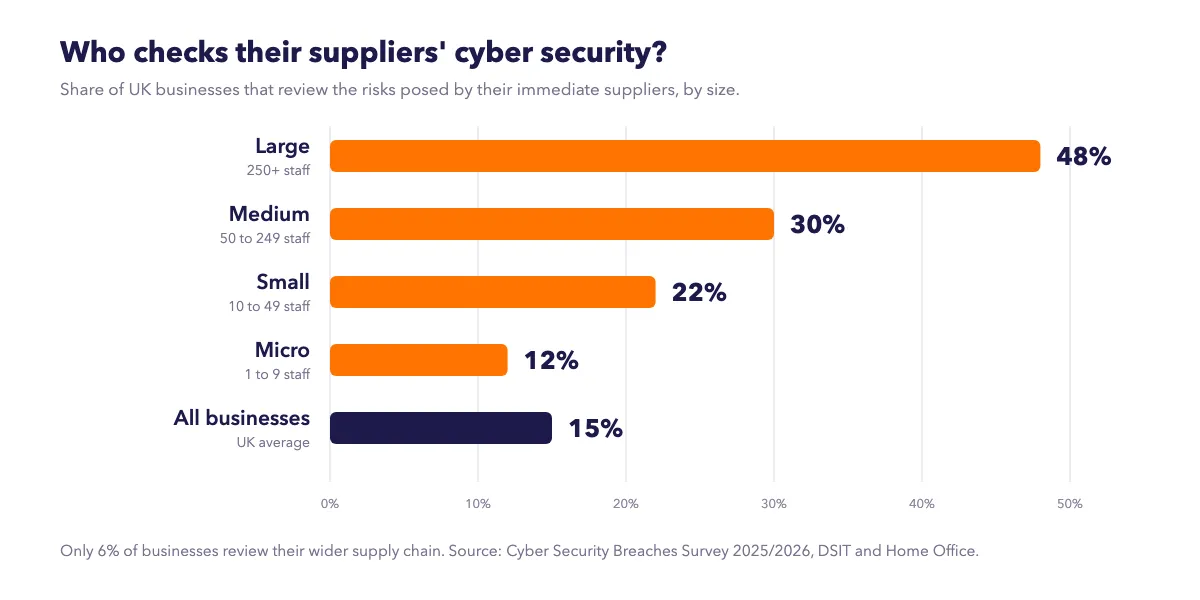
Only 15% of businesses review their immediate suppliers, and only 6% look at their wider supply chain. Even among large businesses it is fewer than half. Set that beside the Verizon figures and the picture is plain: the route attackers use most in retail is the one businesses check least.
The Verizon data is global rather than UK-only, but one detail from its retail analysis is worth repeating. Where third parties were found to have missing or weak multi-factor authentication on cloud accounts, only 23% fully fixed it.
Five incidents, one pattern
| Incident | When | The supplier angle | What it cost |
|---|---|---|---|
| Blue Yonder | November 2024 | Ransomware hit the hosted environment of a supply chain software provider | Morrisons’ warehouse management for fresh and produce was disrupted, and Sainsbury’s moved to contingency plans |
| Marks & Spencer | April 2025 | The chairman told MPs that entry was by sophisticated impersonation and involved a third party | A forecast hit of around £300m to operating profit before mitigation. The 2025/26 results show £131.3m of incident costs and £100m of insurance proceeds |
| Peter Green Chilled | May 2025 | Ransomware at a chilled food distributor serving the major supermarkets | No new orders could be processed. One small food brand put its stock at risk at roughly £100,000 |
| Harrods | September 2025 | Customer records were taken from a third-party provider | About 430,000 eCommerce customer records: names, contact details and marketing labels |
| ASOS | October 2026 | An employee account was obtained by impersonating a trusted contact, then used to reach third-party platforms ASOS uses | Names and contact details exposed, and an estimated £4m to £8m of lost sales |
Sources: M&S results, May 2025 and May 2026; The Register on Peter Green Chilled; BleepingComputer on Harrods and ASOS; PA on the ASOS trading update.
Three things stand out. None of these began with a flaw in the retailer’s own website. The data taken was mostly names and contact details rather than card numbers, which is still a reportable breach and still feeds phishing against your customers. And the smallest business in the chain often carried the most pain: when Peter Green Chilled stopped taking orders, it was the small brands with pallets in its cold store that faced writing off stock.
The pressure is also rising into peak. SonicWall reported this month that intrusion attempts against the UK retailers it monitors are running at roughly 169% above last year’s full-year total on an annualised basis. That is one vendor’s sensor data and it counts blocked attempts, not breaches, but the direction is consistent with everything else.
Where your supplier exposure really sits
Most retailers think of suppliers as the people who send them stock. For cyber risk, the list that matters is different. Ask of each one: do they hold our data, have a login, or run code on our site?
- The eCommerce platform and its apps. Every installed app or plugin has permissions, often to read orders and customers. Old apps nobody uses still have them.
- Scripts on your pages. Analytics, chat, reviews, tag managers and A/B testing tools all run in your customers’ browsers. A tampered script on a checkout page can skim card details. PCI DSS has required retailers to inventory and authorise payment page scripts, and to detect changes to them, since 31 March 2025.
- Agencies, freelancers and managed service providers. Anyone with admin access to your store, hosting or code repository. Their laptop is part of your perimeter.
- Marketing, CRM and customer service tools. These hold a full copy of your customer list.
- Warehouses, 3PLs and carriers. They hold names and addresses, and if they stop, you stop.
- Product suppliers and dropshippers. Shared portals, stock feeds and invoices. A hijacked supplier mailbox asking you to “update our bank details” is one of the most common frauds there is.
Eight checks to run on your suppliers
These follow the shape of the National Cyber Security Centre’s supply chain security principles: understand the risk, establish control, check, and keep improving.
1. Write the list
One spreadsheet: every supplier, what data they hold, what access they have, who owns the relationship. Most teams find suppliers they had forgotten within the first hour.
2. Rank by damage, not by spend
A £20 a month app with read access to every order is a bigger risk than your largest stock supplier. Sort the list by what an attacker could do with that supplier’s access, and spend your effort on the top ten.
3. Give each supplier the least access that works
Named accounts rather than shared logins. Staff-level permissions rather than admin unless admin is needed. API keys scoped to one job. Access that expires when the project ends.
4. Require multi-factor authentication on every account that touches your systems
That includes agency accounts and support logins. The NCSC’s advice to retailers after the 2025 attacks put multi-factor authentication first.
5. Fix the help desk route
The same NCSC advice tells retailers to review how password resets are verified. Ask your suppliers how they verify a caller who claims to be you, and decide how your own team verifies a caller who claims to be them. Agree a call-back number in advance.
6. Ask for evidence, in proportion
For most suppliers, Cyber Essentials is a reasonable minimum. It covers five controls (firewalls, secure configuration, security updates, user access control and malware protection), costs from £320 plus VAT, and the Plus version adds independent testing. For suppliers at the top of your list, ask more: ISO 27001, a recent penetration test summary, and who their own critical suppliers are.
7. Remove what you no longer use
Uninstall old apps, delete former agencies’ accounts, revoke old API keys, and take unused scripts off the site. Every one removed is a route closed, and it costs nothing.
8. Verify any change to payment details by phone
Use a number you already hold, never one from the email asking for the change. Make it a rule with no exceptions for urgency.
What to put in the contract
Under UK GDPR, a supplier that processes personal data for you must do so under a written contract, and the ICO expects breach reporting to be part of it. When a contract is next up for renewal, check it covers these points.
- Notification time. A fixed period, such as 24 hours from discovery, in which the supplier must tell you about an incident affecting your data or service. “Without undue delay” alone is too vague to plan around.
- Minimum security standard. A named certification or control set, kept current for the life of the contract.
- Sub-processors. Your approval before your data is passed to another party, and the same terms flowed down.
- Co-operation in an incident. Access to logs, a named contact, and help with your own reporting duties.
- Exit. Return or deletion of your data, and removal of their access, when the contract ends.
- Right to check. The ability to ask security questions annually and receive answers.
If a supplier is breached: the first 72 hours
The 72 hours matter because, under UK GDPR, a controller must report a notifiable personal data breach to the ICO within 72 hours of becoming aware of it. Your supplier’s breach starts your clock.
- Hour 0 to 4, contain. Disable the supplier’s accounts, rotate any API keys and passwords they held, and pause integrations and data feeds. You can switch them back on later.
- Hour 4 to 24, establish the facts. What data of yours did they hold? What access did they have? Is there any sign that access was used? Check your own logs rather than relying only on their assurance.
- Hour 24 to 72, decide and report. Assess whether the breach is reportable and, if so, report to the ICO within the deadline. Information can follow in phases. If the risk to customers is high, tell them plainly what was taken and what to watch for.
- After, verify before reconnecting. Treat the supplier’s systems as untrusted until they can show the cause was found and fixed. Then update your supplier list with what you learned.
Write this down now, with names and phone numbers next to each step. The middle of an incident is the wrong time to find out who has the admin login.
The law is moving towards your suppliers
The Cyber Security and Resilience Bill has completed its Lords stages and, at the time of writing, is awaiting Commons consideration of Lords amendments. It is not yet law. Retail is not one of the regulated sectors, so an ordinary retailer will not be directly in scope.
Its effect on retailers is indirect. According to the government’s factsheets, medium and large managed service providers and data centres come into scope. They will have to notify the regulator of a significant incident within 24 hours, follow with a fuller report within 72 hours, and notify affected customers. Regulators will also be able to designate individual businesses as critical suppliers. Most of the duties start later, through secondary legislation, but the direction is settled: your larger IT suppliers will soon be legally required to tell you when something goes wrong.
You are a supplier too
The Jaguar Land Rover attack in 2025 ran the other way. The manufacturer was hit, production stopped for about five weeks, and the Cyber Monitoring Centre estimated a £1.9bn cost to the UK economy across more than 5,000 organisations, most of them suppliers.
If you sell to other businesses, or to a marketplace, the questions in this article are about to be asked of you. Larger customers are tightening supplier requirements, and a retailer or wholesaler that can produce a Cyber Essentials certificate, a supplier list and an incident plan will find those conversations short. One that cannot may find them ending.
Where to start this week
Do checks 1, 7 and 8 first. Write the list, remove what you no longer use, and put the phone call rule in place for bank detail changes. None needs budget, and together they close the routes that most small and mid-sized retailers leave open.
If the list shows access you cannot easily untangle, such as shared admin logins, an agency that left years ago, or integrations nobody can explain, that is a platform job. Our managed eCommerce team audits and tidies store access, apps and integrations for UK retailers, and our maintenance and support service keeps them patched afterwards. If you would like a second pair of eyes on your supplier list, get in touch. The first conversation is free.
Frequently Asked Questions
What is a supply chain attack?
It is an attack that reaches you through a business you depend on rather than through your own defences. The route can be a supplier's software (a compromised update, plugin or script), a supplier's service (a hosted platform, a managed IT provider, a logistics partner), or a supplier's access (a login, API key or support account that works on your systems).
If my supplier is breached, who has to report it to the ICO?
You do, if you are the data controller and the breach is reportable. Under UK GDPR your supplier, as processor, must tell you without undue delay, and you must report a notifiable breach to the ICO within 72 hours of becoming aware of it. Your customers gave their data to you, so the duty to tell them when the risk is high is also yours. This is general information, not legal advice.
Is Cyber Essentials enough to ask of a supplier?
It is a sensible minimum, not a guarantee. Cyber Essentials covers five basic controls, and Cyber Essentials Plus adds independent technical testing of them. Only around 5% of UK businesses hold it, so asking for it already filters suppliers. For any supplier with admin access to your store or a copy of your customer data, ask further questions about multi-factor authentication, who their own suppliers are and how quickly they will tell you about an incident.
Does the Cyber Security and Resilience Bill apply to online retailers?
Not directly. As of mid-November 2026 the Bill has not received Royal Assent, and retail is not one of the regulated sectors. It does bring medium and large managed service providers and data centres into scope, with duties to report significant incidents and to notify affected customers, so retailers should feel it through their suppliers.