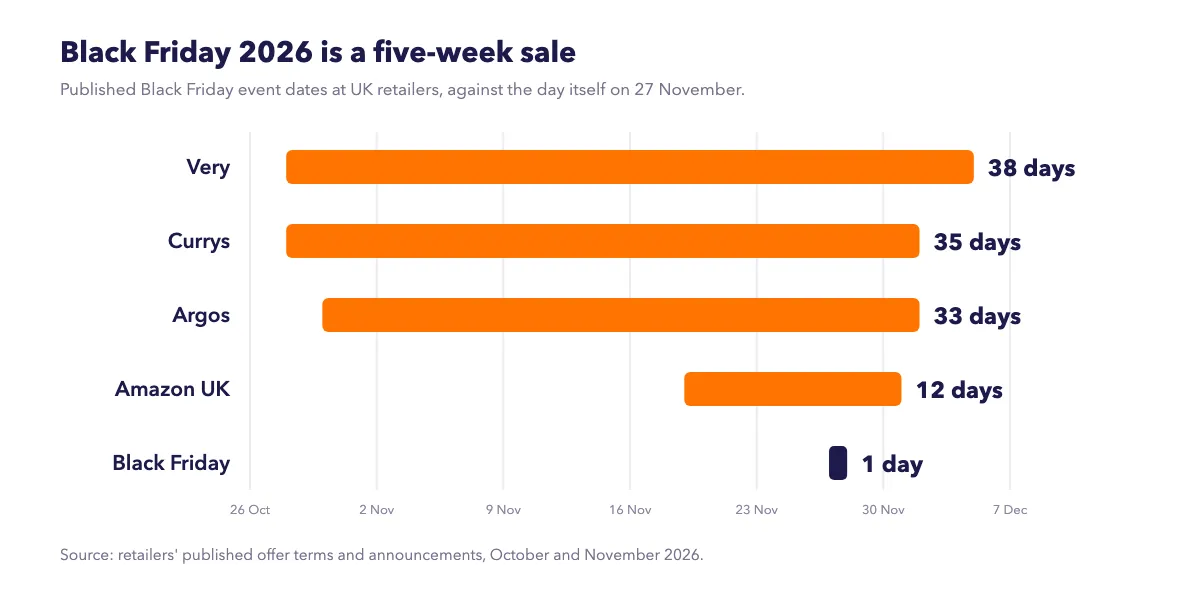
Black Friday is on 27 November. For the largest UK retailers it started on 28 October. Currys and Very both opened their Black Friday events that day, Argos followed two days later, and all three run into December. What used to be a day, then a weekend, then a week, is now five weeks of continuous promotion.
Shoppers have adjusted faster than most retailers. They start earlier, they compare harder, and many of them hold back the purchase until they are confident the price will not fall again. For a small or mid-sized online retailer, that changes what a good Black Friday plan looks like. The question is no longer “what is our offer on the day?” but “how do we trade five weeks without discounting for all of them?”
This article sets out what this year’s sale calendar looks like, what the data says about how shoppers behave in a long sale, and eight practical ways to trade it. Black Friday is nine days away as this is published, so the last section covers what can still be changed in time.
The sale now lasts five weeks
| Retailer | Black Friday event, 2026 | Length |
|---|---|---|
| Very | 28 October to 4 December | 38 days |
| Currys | 28 October to 1 December | 35 days |
| Argos | 30 October to 1 December | 33 days |
| Amazon UK | 19 to 30 November | 12 days |
Dates are as published in the retailers’ own offer terms and announcements, reported by Retail Technology Innovation Hub and deal trackers. Several other large retailers were also reported live by early November.
The creep is steady rather than sudden. Currys opened one day earlier than last year, and Amazon’s event is the same length as in 2025. But the direction has been the same for years, and the result is that most of November is now sale season.
How shoppers behave in a long sale
Three findings from this month’s research describe the shopper you are selling to.
- They start early. Barclays’ forecast, published on 17 November, found that three in five shoppers plan to begin before Black Friday week. It expects 46% of UK adults to take part, up from 43%, spending more than £10.5bn.
- They also wait. KPMG’s survey of 3,000 UK consumers, reported by Retail Times, found that 49% of those planning or considering a purchase had held off buying until the promotional period. Among Gen Z it was 71%.
- They are not sure they believe you. In the same KPMG survey, 23% said they would buy nothing, and almost half of those said they do not think the prices are better than at other times of year. Which? tracked 175 products across eight major retailers for its most recent study, published in November 2025, and found that 83% were the same price or cheaper at some point outside the four-week sale period. None was at its lowest price of the year on Black Friday itself.
Those three facts pull against each other, and that is the difficulty. A shopper who starts browsing in early November but suspects a better price is coming will look, leave, and come back on the 27th, or buy from whoever gives them a reason to commit now.
The forecasts themselves disagree about how much they will spend. Barclays and Adobe expect growth. Omnisend’s survey of spending intentions found UK shoppers planning to spend 32% less per head than last year, £267 against £390. Plan for a careful shopper rather than a generous one.
What last year’s numbers showed
The 2025 results make the case that the day matters less than it did.
- Most of the season’s money is spent outside the big weekend. Adobe’s UK figures, reported in January, put November and December online spending at £26.9bn. The four days from Black Friday to Cyber Monday took £3.8bn of that, and Black Friday itself £1.16bn. On those figures, about 86% of the season’s online spend fell outside the four-day weekend.
- The spike on the day is shrinking. Barclays reported that transactions on Black Friday 2025 were 62% above an average day. In 2024 the uplift was nearly 84%.
- Monday can be bigger than Friday. Delivery platform Scurri reported that order volume on Cyber Monday 2025 was nearly 70% higher than on Black Friday across its retailers, and that the peak hour for conversions on both days was 5pm.
- More visits did not mean more revenue. The IMRG and RevLifter review of more than 250 retailers found traffic up on almost every day of Black Friday week 2025, while revenue fell on five of the eight days.
That last point is the warning. A longer sale brings more browsing. It does not, by itself, bring more money, and if the same demand is spread across five weeks at a discount, it can bring less.
Eight ways to trade a month-long sale
1. Phase the offer by purpose, not just by depth
The lazy version of a long sale is the same discount for five weeks, or a discount that deepens each week and teaches customers to wait. Give each phase a different job instead.
- Early weeks: offers that do not reset your price. Free delivery, bundles, gifts with purchase, early access for existing customers.
- Black Friday week: your real price cuts, on a defined range, for a defined period.
- Cyber Monday into December: clearance of what is left, and gifting lines with a delivery promise.
Adobe expects average discounts to climb from 12% in early November to 25% over Cyber Weekend. That is the market drifting. Our Christmas forecast article covers the discount ladder in detail.
2. Give early buyers a reason not to wait
The big retailers’ answer to the waiting shopper is the price promise. Currys, Very and Argos will each refund the difference if a Black Friday product bought during their sale drops in price again before a set date. As Very’s chief executive put it, customers “can shop our deals as soon as they see them”.
A smaller retailer can offer the same thing with less machinery: a clear statement that anyone who buys in the campaign period and sees the price fall before it ends can claim the difference. In practice claims are a small share of orders, and the promise converts the browser who would otherwise leave. Decide the dates, write the terms plainly, and make sure your order system can produce the list.
3. Set a margin floor per order
Over five weeks, discounts stack: the sale price, a welcome code, a basket threshold offer, free delivery and an abandoned basket email can all land on one order. Set a minimum margin per order rather than per campaign, block code combinations that breach it, and review the worst orders daily. One person should have authority to pull a promotion that is losing money.
4. Fix your dates and keep them
A long sale creates more ways to break the pricing rules. A “was” price needs to be one customers genuinely paid, which is harder to show when the product has been on offer for five weeks. An end date must be real, and extending the sale because it is going well turns the original deadline into a false urgency claim. The Competition and Markets Authority has fined retailers for exactly this in 2026. Our guide to the nine pricing rules for Black Friday has the detail.
5. Lead with delivery and returns
KPMG asked shoppers what would tempt them. Free delivery came top at 40% and free returns second at 22%. Both can be cheaper to give than a further 10% off, and neither lowers your reference price.
Put delivery cut-off dates on product pages now. Royal Mail’s last recommended posting dates for Christmas 2026, as published by ShipStation, are 18 December for 2nd Class, 21 December for 1st Class and Tracked 24, and 23 December for Special Delivery Guaranteed. Check your own carrier’s dates before you publish them, and remember that Royal Mail caps business collections in November and December at three times your usual volume.
6. Staff and stock for Monday and for 5pm
If last year’s pattern holds, your busiest day for orders may be Cyber Monday rather than Friday, and your busiest hour early evening rather than midnight. Plan customer service cover, warehouse shifts and paid media budgets around that. Hold back some stock of your best sellers so Monday is not a page of sold-out lines.
Load test before the 27th, not on it. A site that slows at 5pm on Black Friday loses the hour that matters most. Our guide to scaling from 100 to 10,000 orders a month covers the technical side.
7. Pace your email and look after the customers who come direct
KPMG found that 53% of shoppers find deals by going straight to a retailer’s site or app, and 30% rely on retailer emails. Your own customers are your cheapest traffic in the most expensive advertising month of the year.
Five weeks of daily emails will burn the list. Increase volume gradually, segment by what people have browsed or bought, suppress customers who have just ordered, and give each phase one clear message. Make the site’s homepage and search show the current offer the moment a returning customer arrives.
8. Measure the campaign, not the day
If you judge the sale on Black Friday’s sales against last year’s Black Friday, a five-week campaign will look like a failure even when it is working. Compare the whole period, 28 October to early December, with the same weeks last year, and track four numbers.
- Revenue and gross margin for the period, not the day.
- Average discount per order, daily.
- New against returning customers, because a sale that only brings forward your regulars’ purchases has cost you margin for nothing.
- Return rate by phase, when the January returns arrive.
What you can still change in nine days
A new platform or a new campaign is out of reach. These are not.
- Today: fix and publish your end dates, and write a price promise if you want one.
- This week: set the margin floor and block the code combinations that breach it. Put delivery cut-off dates on product pages.
- Before the 27th: load test, move staffing towards Cyber Monday and the early evening, and hold back stock of best sellers.
- On the day: watch conversion, error rate and discount per order by the hour, with someone able to act.
- Afterwards: report on the whole period, and write down what you would do differently while you still remember.
The longer view
The month-long sale is not going away. The largest retailers have settled into it, and shoppers now expect it. The retailers who do well are not the ones who discount longest. They are the ones who decide in advance what each week is for, protect their margin order by order, and give the cautious shopper a reason to buy now from them.
If your platform cannot schedule phased promotions, enforce a margin floor or report on the campaign as a whole, that is a build job, and it is what our managed eCommerce team does for UK retailers. To talk through your peak plan, get in touch. The first conversation is free.
Frequently Asked Questions
When does Black Friday 2026 actually start in the UK?
Black Friday itself is Friday 27 November and Cyber Monday is 30 November, but the sales began a month earlier. Currys and Very opened their Black Friday events on 28 October and Argos on 30 October, running into the first days of December. Amazon's Black Friday Week runs from 19 to 30 November.
Should a small online retailer start its Black Friday sale early?
Not necessarily with its deepest discount. Barclays found that three in five shoppers plan to start before Black Friday week, so being absent in early November costs sales. But an early offer does not have to be a price cut: free delivery, bundles, early access for existing customers and a promise to refund the difference if the price drops later all bring early orders without setting your lowest price for five weeks.
What is a Black Friday price promise?
It is a commitment that if a retailer cuts the price of a product again during its sale, customers who bought earlier in the sale can claim the difference back. Currys, Very and Argos are all offering one in 2026. It removes the shopper's reason to wait for the day itself, which is why it suits a long sale.
Is it too late to change our Black Friday plan?
No. With nine days to go you can still fix your end dates, set a margin floor per order, publish delivery cut-off dates on product pages, move staffing and stock towards Cyber Monday and the early evening peak, and set up reporting that compares the whole campaign period with last year rather than one day.